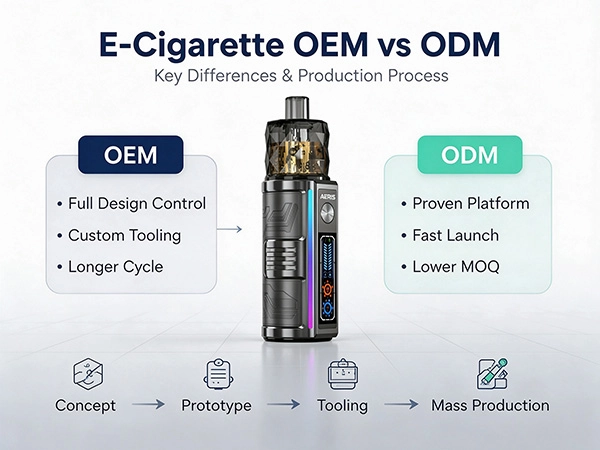
E-cigarette OEM and ODM services have become mainstream choices for global vape brands. Brand owners entrust product design, raw material procurement and mass production to professional contract manufacturers. One of the biggest challenges in vape contract manufacturing is keeping stable product consistency across thousands or millions of finished units. Slight deviations in hardware, e-liquid or assembly will cause inconsistent vaping experience, customer complaints and brand reputation losses. This article explains key production links and quality control measures for consistent e-cigarette OEM output.
Raw Material Incoming Inspection: The First Barrier of Consistency
Unstable raw materials are the primary cause of inconsistent finished e-cigarettes. Reliable OEM factories implement strict incoming material inspection before any production starts. All components including batteries, atomizing cores, silicone seals, plastic housings, mouthpieces and e-liquid raw materials must pass batch testing.
For battery cells, manufacturers check actual capacity, internal resistance and discharge curve of each batch. Atomizer cores are sampled to verify heating resistance and wicking performance. E-liquid batches undergo tests for nicotine concentration, PG/VG ratio, flavor profile and impurity content. If any raw material batch fails the standard, the whole batch will be rejected and cannot enter production. Uniform raw material quality lays the foundation for consistent final products.
Standardized Production SOP to Unify Operation Standards
Manual operation differences easily bring product variations. Professional e-cigarette OEM factories build detailed SOP (Standard Operating Procedures) covering every production station. Workers follow unified operation guidelines for component assembly, e-liquid filling, sealing and testing.
Automation equipment is widely adopted to reduce human error. Automatic filling machines control e-liquid injection volume precisely; automated assembly lines fix the installation torque of structural parts. All production parameters such as filling temperature, pressure and assembly sequence are recorded for each production lot. When switching to a new batch, technicians calibrate machines again to avoid parameter drift. SOP standardization ensures every product is made under identical manufacturing conditions.
In-line Sampling & Real-time Monitoring During Mass Production
Consistency control cannot only rely on final finished product inspection. In-line quality checks run through the whole production process. Quality teams take random samples at key stations after atomizer assembly, e-liquid filling and sealing.
Inspectors check appearance, sealing condition, resistance value and leakage risk of sampled units. Any abnormal data will trigger an immediate production pause for root cause analysis. Common issues include loose sealing, uneven e-liquid dosage and unstable atomizer resistance. The production team adjusts equipment or replaces defective components before continuing mass production. Real-time monitoring prevents large quantities of non-conforming products from being produced.
Finished Product Aging Test & Batch Sampling Verification
After assembly, finished e-cigarettes enter the aging test stage. Products are activated for a certain period to simulate real storage and vaping conditions. This step helps expose hidden problems such as liquid leakage, voltage drop and flavor shift that cannot be detected right after production.
After aging, batch sampling is carried out for comprehensive performance testing. Test items include output voltage, puff count, vapor volume, flavor consistency and leakage rate. All test data of each batch is archived. For OEM orders, manufacturers can provide batch test reports for brand customers. Products that meet all specifications will move to packaging, while non-compliant products are isolated and reworked or scrapped.
Traceability System for Batch Management
Complete batch traceability is essential to maintain product consistency and handle after-sale issues. Every production lot has a unique batch number linked with raw material batch records, equipment operation logs and inspection reports.
If end users report inconsistent vaping experience for a certain batch, manufacturers can quickly trace back to raw material suppliers, production shift records and test data. The traceability mechanism helps identify problem sources rapidly and optimize the process for subsequent OEM orders. Good batch management also supports compliance requirements for global e-cigarette markets.
Environmental Control in Production Workshop
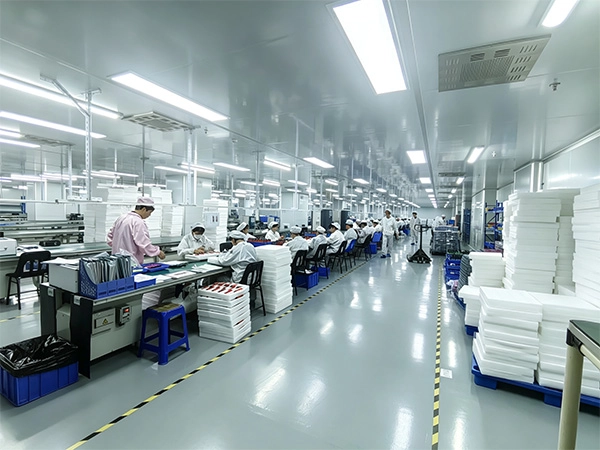
E-cigarette components like atomizing cores and e-liquid are sensitive to temperature, humidity and dust. Advanced OEM factories use dust-free workshops with constant temperature and humidity control. High humidity may affect e-liquid properties and silicone sealing performance; excessive dust can block atomizer channels and cause unstable vapor.
Workshop environment parameters are monitored and recorded continuously. Staff must follow dressing and operation rules to reduce contamination. Stable manufacturing environment eliminates environmental interference and further stabilizes product performance between batches.
For e-cigarette OEM and ODM cooperation, product consistency is the core competitiveness of contract manufacturers. Stable output depends on full-chain quality control: strict raw material inspection, standardized SOP and automated production, in-line monitoring, finished product aging tests, batch traceability and controlled workshop environment.
When selecting an e-cigarette OEM partner, brand buyers should evaluate the factory’s complete quality control system instead of only focusing on unit price. A reliable vape manufacturer helps brands deliver uniform, stable vaping experience to end consumers and reduce market risks.