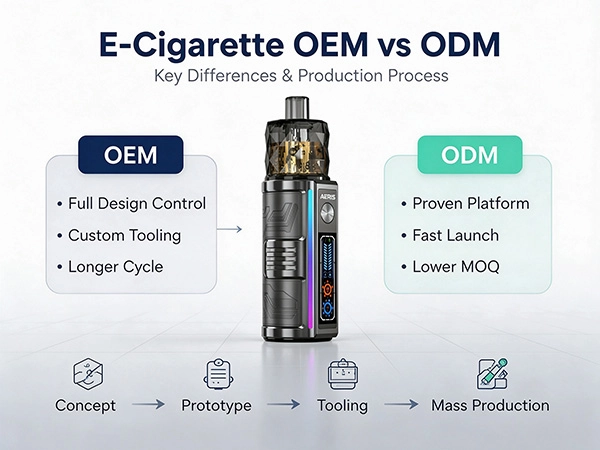
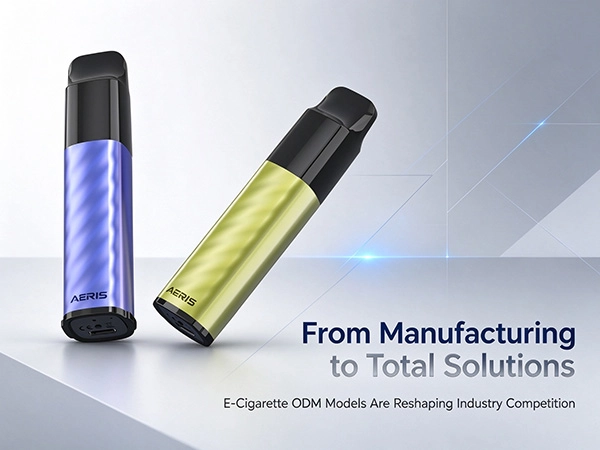
The global electronic cigarette OEM/ODM landscape is undergoing its most profound restructuring in a decade. Driven by cascading regulatory reforms across major markets, fundamental shifts in China’s export tax framework, and the rise of alternative manufacturing hubs in Southeast Asia, the traditional low-cost, high-volume contract manufacturing model that defined the industry’s growth phase is rapidly becoming obsolete. For China’s vast ecosystem of vaping factories—concentrated overwhelmingly in the Shenzhen-Dongguan manufacturing corridor—this seismic shift presents both existential threats and historic opportunities to ascend the value chain. As the industry moves from unregulated expansion to compliance-driven consolidation, factories that can navigate new cost realities, build regulatory expertise, and deliver differentiated product capabilities will emerge as the long-term winners in the global supply chain.
Key Forces Reshaping the Global Vaping OEM/ODM Order
Three interconnected forces are dismantling the old competitive order and rewriting the rules for contract manufacturing in the vaping sector.
First, global regulatory convergence is raising the barrier to market entry for both brands and their manufacturing partners. In the United States, intensified FDA enforcement of Premarket Tobacco Product Application (PMTA) requirements has led to a 73% year-over-year increase in import refusals for Chinese-origin vape shipments through the first half of 2026, as customs authorities step up screening for products lacking formal marketing authorization. This has fundamentally shifted order composition for Chinese exporters: PMTA-authorized brand clients now account for 41% of production volume at leading Shenzhen facilities, up from just 22% in mid-2025. In Europe, the proposed TPD3 revision would impose a bloc-wide ban on disposable vaping devices and reduce maximum nicotine concentration from 20mg/mL to 10mg/mL, forcing OEMs to rapidly retool production lines toward compliant reusable pod systems. The pace of this transition is unprecedented, with major Guangdong-based manufacturers reporting a 21% quarter-over-quarter shift in capacity from disposables to TPD-compliant platforms.
Second, China’s domestic policy adjustments have removed the fiscal foundation that supported many smaller contract manufacturers. The elimination of the 13% export VAT rebate for e-cigarette products, effective April 1, 2026, removed an $8.3 billion annual subsidy that had effectively become the primary profit buffer for factories operating on razor-thin margins. Compounding this, China’s State Tobacco Monopoly Administration has implemented verified capacity management and annual production volume ceilings, prohibiting new greenfield manufacturing projects and restricting capacity expansion. This regulatory squeeze is accelerating industry consolidation: smaller pure contract factories with limited differentiation face critical pressure to exit or be acquired, while mid-tier OEMs are being forced to choose between building proprietary brands or becoming captive suppliers to larger players.
Third, the emergence of Southeast Asia as an alternative manufacturing base is introducing new competitive dynamics. Indonesia and Malaysia have become primary destinations for production offshoring, driven by lower operating costs, favorable regulatory treatment, and strategic proximity to growing domestic markets. Major Chinese industry players have already established production facilities in Indonesian locations including Batam and Malang, with additional investments planned in Vietnam. While these offshore facilities currently lag behind Shenzhen in technological sophistication and supply chain integration, they are rapidly closing the gap and capturing price-sensitive order flow, particularly for entry-level disposable products.
Core Opportunities for Chinese E-Cigarette OEM/ODM Manufacturers
Despite these headwinds, China’s vaping manufacturing sector retains structural advantages that position leading factories to capture disproportionate value as the market consolidates.
The most significant opportunity lies in the growing scarcity of verified, compliance-ready manufacturing capacity. As regulatory requirements become more stringent globally, global brands and major tobacco companies are actively consolidating their supplier bases to reduce compliance risk. This is driving a pronounced concentration of orders toward larger, well-established Chinese OEMs that possess deep regulatory expertise, established certification track records, and the quality systems required to support PMTA, TPD and other regional compliance frameworks. For factories that have already invested in regulatory affairs teams and testing infrastructure, this shift translates into longer-term contracts, higher order visibility, and reduced price competition compared to the commoditized mass market.
Technological leadership remains China’s most enduring competitive moat. The Shenzhen ecosystem accounts for over 80% of global vaping hardware production and dominates core intellectual property in areas including ceramic coil technology, advanced battery management, and automated manufacturing systems. This technology advantage allows Chinese ODMs to lead the industry in next-generation product development, from smart vaping devices with digital controls to advanced closed-pod systems and heat-not-burn platforms. As the market shifts away from simple disposables toward more sophisticated, regulated products, the engineering and R&D capabilities of top Chinese manufacturers become increasingly indispensable for global brands lacking in-house hardware expertise.
Additional growth opportunities are emerging from fast-emerging regional markets. While mature markets in North America and Europe face regulatory constraints, regions including Latin America, the Middle East, and Southeast Asia are experiencing rapid growth in vaping adoption. Local brands in these markets increasingly seek Chinese OEM/ODM partners that can deliver cost-effective, market-adapted products with speed and scalability. Furthermore, the shift toward extended producer responsibility (EPR) and environmental compliance in Europe and other developed markets creates a first-mover advantage for Chinese manufacturers that invest in take-back logistics, recycling systems, and sustainable material sourcing—capabilities that are quickly becoming hard prerequisites for securing contracts with major retail chains.
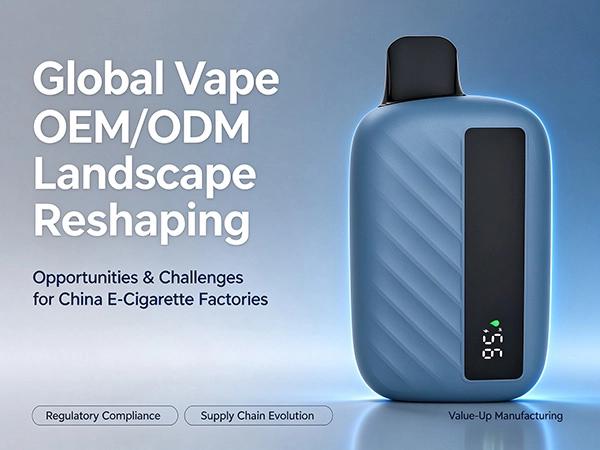
Pressing Challenges Facing China’s Vaping Contract Manufacturing Sector
The path forward is not without significant obstacles, and factories across all tiers face mounting operational and strategic challenges.
Cost structure deterioration is the most immediate threat. For many smaller contract manufacturers, the 13% export VAT rebate previously exceeded their entire operating profit margin. Its elimination has forced widespread price increases, but factories lacking differentiated products or strong client relationships struggle to pass costs downstream without losing orders. This is exacerbating a long-standing margin compression problem: typical operating profits for pure contract manufacturers hover around 10%, and the loss of the rebate has pushed many below break-even. Rising raw material costs, stricter environmental compliance requirements, and higher labor costs further erode profitability, particularly for mid-tier and smaller operators.
Regulatory complexity and compliance risk represent a growing structural challenge. The global regulatory environment is increasingly fragmented, with different markets imposing divergent standards for nicotine levels, product testing, packaging, and age verification. Navigating this patchwork requires substantial ongoing investment in regulatory intelligence, certification, and quality control—costs that fall disproportionately on smaller manufacturers. Additionally, China’s domestic export compliance requirements are tightening, with exporters now required to demonstrate adherence to destination country regulations as a condition of maintaining production quotas. For factories accustomed to operating in a lightly regulated environment, building these capabilities represents a major organizational and financial hurdle.
Competitive pressure from Southeast Asian manufacturing hubs continues to intensify. While Chinese factories retain clear advantages in technology, supply chain depth, and production scale, Indonesian and Malaysian facilities are rapidly improving their capabilities and competing aggressively on price for entry-level products. As more Chinese brands and OEMs establish offshore production to mitigate trade risks and access regional markets, domestic factories risk seeing an increasing share of high-volume, price-sensitive orders migrate south. This trend threatens to hollow out the middle tier of China’s manufacturing sector, leaving only the most technology-intensive production and the most commoditized, low-margin work at opposite ends of the spectrum.
Finally, industry consolidation and capacity controls are creating winners and losers at an accelerating pace. The combination of market forces and regulatory policy is driving a clear three-tier stratification: top-tier integrated players with brand equity and regulatory portfolios weather the storm relatively well; mid-scale OEMs face severe pressure to transform or be acquired; and small, pure contract factories face existential risk. For many factory owners, the greatest challenge is not just surviving the current downturn, but deciding which strategic path to pursue in a fundamentally restructured industry.
Strategic Pathways for Chinese OEM/ODM Factories
To thrive in the reshaped landscape, Chinese vaping manufacturers must move beyond price competition and build sustainable competitive advantages along four strategic dimensions.
First, prioritize regulatory compliance as a core competitive capability rather than a cost center. Factories should invest in dedicated regulatory affairs teams, build comprehensive testing infrastructure, and develop deep expertise in key market requirements including FDA PMTA, EU TPD, and regional standards across emerging markets. By achieving and demonstrating full compliance, manufacturers can position themselves as trusted partners for global brands and command premium pricing for low-risk, verified production capacity.
Second, accelerate the transition from OEM to ODM by deepening product development and innovation capabilities. The era of simple white-label manufacturing is drawing to a close; future growth will belong to factories that can deliver complete, market-ready product solutions, from industrial design and formulation to testing and certification. Investing in R&D for next-generation technologies—including advanced atomization systems, smart device features, and sustainable materials—will enable manufacturers to capture higher margins and build stickier client relationships.
Third, pursue selective geographic diversification to hedge regulatory and cost risks. Rather than fully offshoring production, leading manufacturers are adopting a “China + Southeast Asia” dual-base strategy, retaining high-value, technology-intensive production and R&D in China while establishing regional assembly facilities in Indonesia or Malaysia to serve local markets and mitigate trade barriers. This approach preserves the advantages of the Shenzhen supply chain ecosystem while expanding market access and cost flexibility.
Fourth, pursue vertical integration and operational excellence to optimize cost structures. Factories that integrate upstream into key components such as coils, batteries, and e-liquid formulation can achieve greater cost control, quality consistency, and supply chain resilience. Complementing this with investments in automation and lean manufacturing helps offset higher labor and compliance costs while improving production efficiency and product consistency—critical factors for winning contracts with large, quality-conscious global customers.
Conclusion
The global vaping OEM/ODM industry is at a defining inflection point. The forces of regulatory tightening, policy change, and geographic competition are dismantling the old competitive order and creating a new landscape where compliance, technology, and operational excellence determine success. For China’s e-cigarette manufacturing sector, this transition brings short-term pain and widespread industry consolidation, but also clears the way for stronger, more capable players to emerge as global leaders. Factories that proactively invest in regulatory capabilities, upgrade their technology and product offerings, and adapt their business models will not only survive the reshaping—they will capture the majority of value in the next phase of the global vaping market. For international brands and buyers, partnering with forward-thinking Chinese vape manufacturers that have navigated this transition successfully will remain the most reliable path to accessing world-class production capabilities and innovative product solutions.