In the global e-cigarette and vape industry, choosing the right manufacturing partnership is one of the most critical decisions for brands, importers, and distributors. Original Equipment Manufacturing (OEM) and Original Design Manufacturing (ODM) are the two dominant production models, each serving distinct business goals, budget levels, and go-to-market strategies. Understanding their differences and full operational workflows helps you align your product roadmap with your brand’s growth stage, market entry timeline, and competitive positioning.
What Is E-Cigarette OEM?
E-cigarette OEM (Original Equipment Manufacturing) is a client-led production model where your brand provides the complete product concept, technical specifications, design blueprints, and functional requirements, and the manufacturer handles engineering, tooling, prototyping, and mass production according to your exact standards.
In an OEM partnership, you retain full control over every detail of the product, from internal hardware structure, PCB configuration, and battery capacity to e-liquid formula, exterior shape, material finish, and packaging design. The manufacturer acts as an execution partner, translating your design into finished goods while adhering to your quality control protocols and regulatory compliance requirements. This model is ideal for established brands that have in-house R&D capabilities, clear product differentiation strategies, and proprietary intellectual property that needs to be protected.
What Is E-Cigarette ODM?
E-cigarette ODM (Original Design Manufacturing) is a manufacturer-led model where the supplier develops and owns pre-engineered product platforms, mature device architectures, and proven e-liquid formulations. Your brand selects from these existing solutions and customizes them with your own branding, colorways, flavor adjustments, packaging artwork, and minor configuration tweaks.
ODM eliminates the heavy lifting of end-to-end product development, as the core hardware, tooling, and formulation have already been validated through market testing. You can brand the final product as your own without investing in upfront design and engineering resources. This model is preferred by startups, regional distributors, and brands that prioritize fast market entry, lower upfront investment, and reduced product development risk.
Core Differences Between E-Cigarette OEM and ODM
Design Leadership and IP Ownership
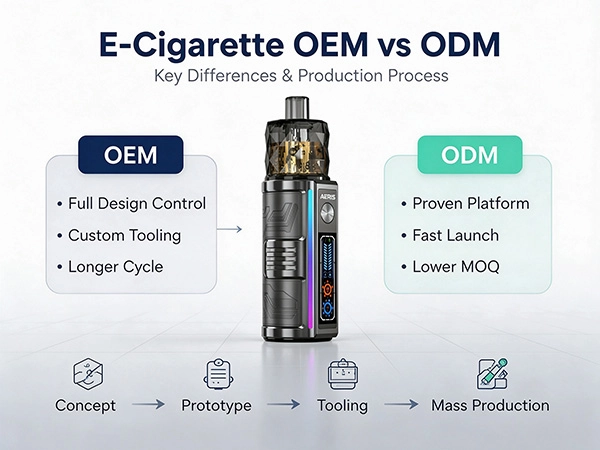
The most fundamental difference lies in who drives the product design. In OEM projects, your brand initiates the concept, owns the design IP, and makes all final decisions on product specifications. The manufacturer only executes production based on your approved design package. For ODM projects, the manufacturer owns the base design, core technology platform, and existing tooling. Your customization rights are limited to branding, appearance, and non-structural adjustments within the boundaries of the existing platform.
Customization Depth
OEM delivers the highest level of customization flexibility. You can define every aspect of the device, including unique form factors, custom internal components, exclusive e-liquid recipes, specialized airflow systems, and proprietary smart features. ODM offers moderate customization constrained by the existing product framework. Typical adjustments include logo printing, color matching, flavor strength tuning, packaging design, and simple functional modifications; major structural changes require additional tooling investment and extend project timelines.
Development Cycle and Time-to-Market
OEM projects typically have longer development cycles because they involve full engineering design, prototype iteration, custom tooling fabrication, and comprehensive performance validation. For fully custom hardware, the development phase before mass production usually ranges from 60 to 75 days, depending on design complexity. ODM projects have significantly shorter lead times, as the core product platform and tooling are already in place. Most ODM orders can move to mass production within 25 to 30 days after sample and artwork confirmation, enabling much faster time-to-market.
Cost Structure and MOQ Requirements
OEM carries higher upfront costs, including design engineering fees, custom mold tooling charges, prototype testing expenses, and production line setup costs. The minimum order quantity (MOQ) for full OEM projects is generally higher, often starting at 10,000 units per model, to justify the initial investment in custom tooling and development. ODM has lower upfront expenditure with no or minimal tooling fees, and the MOQ threshold is more flexible, making it accessible for smaller batch orders and market testing.
Full Production Process Breakdown From Concept to Mass Production
OEM Full Production Workflow
The OEM process follows a structured, client-centric path from initial idea to finished goods:
1. Requirement Consultation & Scope Definition
You share your product concept, technical specifications, target market, compliance requirements, and volume expectations. The manufacturer conducts feasibility assessment, confirms technical realizability, and provides preliminary cost estimates and timeline projections.
2. Design & Engineering Development
The manufacturer’s engineering team translates your requirements into detailed technical drawings, 3D renderings, and BOM (bill of materials) lists. This stage covers structural design, electronic circuit design, software programming, and e-liquid formulation development, with regular review checkpoints for your approval.
3. Prototype Fabrication & Verification
Working prototypes are produced for functional testing, ergonomic evaluation, and performance validation. You test the prototypes for battery life, vapor production, flavor consistency, leak resistance, and overall user experience, then provide feedback for revisions. This iterative process continues until the prototype meets all your specifications.
4. Tooling Development & Compliance Certification
Once the prototype is finalized, custom molds and production tooling are fabricated. The manufacturer conducts pilot production runs to test manufacturing stability, and supports you in completing regional regulatory certifications such as TPD, FDA, or CE marking.
5. Mass Production Preparation
Raw material sourcing, production line scheduling, quality control standard setup, and personnel training are completed before full-scale manufacturing begins. All materials and components are inspected upon arrival to ensure consistency with approved specifications.
6. Batch Manufacturing & In-Process Quality Control
Mass production proceeds according to the agreed schedule. Strict QC inspections are implemented at every production stage, including incoming material inspection, semi-finished product testing, finished product function testing, and appearance checks.
7. Branding, Packaging & Final Delivery
Custom branding, packaging assembly, and final quality audits are completed. Finished goods are packed according to shipping requirements, and the manufacturer coordinates global logistics and delivery to your designated destination.
ODM Full Production Workflow
The ODM process is streamlined by leveraging existing product platforms:
1. Platform Selection & Requirement Confirmation
You review the manufacturer’s existing product catalog, select a base device model and e-liquid formulation that matches your market positioning, and define your customization requirements for branding, colors, flavors, and packaging.
2. Customization Adjustment & Quotation
The manufacturer confirms the feasibility of your requested customizations, provides a detailed quotation including unit price, sample cost, lead time, and MOQ, and clarifies the scope of adjustable features within the existing platform.
3. Sample Production & Approval
Pre-production samples are manufactured with your custom branding, color scheme, flavor profile, and packaging design. You evaluate the samples for quality, appearance, and performance, and request revisions if needed before final confirmation.
4. Order Confirmation & Production Scheduling
After sample approval, you formalize the order with a signed agreement and deposit. The manufacturer arranges raw material preparation and production slot scheduling based on your required delivery date.
5. Mass Production & Quality Assurance
Standardized mass production is carried out using mature manufacturing processes and existing tooling. The manufacturer applies consistent quality control measures throughout production to ensure product consistency and compliance with agreed specifications.
6. Packaging, Inspection & Shipment
Finished products receive your custom packaging and undergo final batch inspection. The manufacturer arranges export documentation, customs clearance support, and international shipping to deliver the goods to your market.
How to Choose Between OEM and ODM for Your Vape Brand
Your choice between OEM and ODM should align with your brand’s stage, resources, and strategic objectives. If you are a new brand entering the market for the first time, or testing demand in a new regional market, ODM is the practical starting point that minimizes financial risk and accelerates your launch timeline. If you are an established brand with a clear product roadmap, strong market presence, and a need for unique product differentiation to stand out in a competitive landscape, OEM delivers the customization depth and IP ownership required for long-term brand building.
Many successful vape brands use a hybrid strategy: starting with ODM to validate market demand and build brand recognition, then transitioning to OEM for core product lines as they scale. This approach balances speed-to-market with long-term product competitiveness.
Final Thoughts
Both e-cigarette OEM and ODM manufacturing models offer distinct value propositions for global vape businesses. OEM empowers you with full creative control and exclusive product identity, while ODM provides a fast, cost-effective path to market with proven product solutions. By understanding their core differences and end-to-end production processes, you can select the right manufacturing partner and model that matches your brand’s growth trajectory, budget, and market goals.