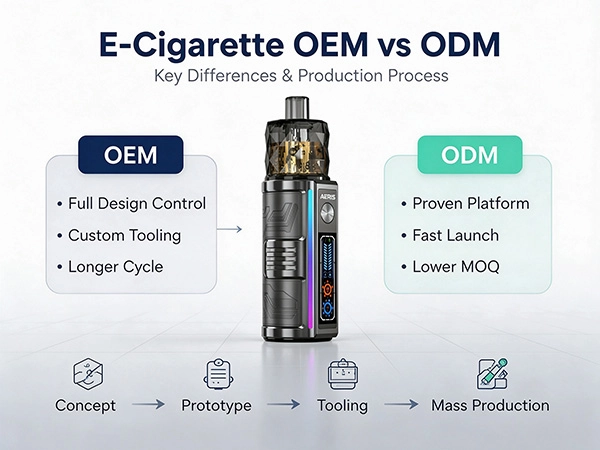
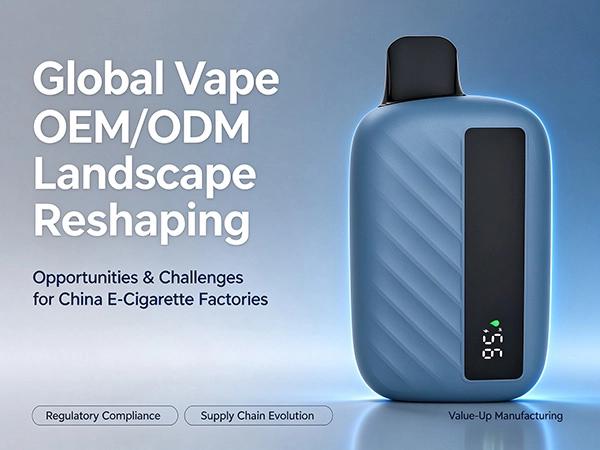
For over a decade, the global electronic cigarette supply chain ran on a straightforward model: brands designed products, and Chinese factories manufactured them to specification. Traditional OEM and early-stage ODM services focused almost exclusively on production efficiency, unit cost reduction, and volume delivery, competing primarily on price and lead time. Today, however, a fundamental restructuring is underway. Leading e-cigarette ODM providers are evolving from pure manufacturing partners into full-stack solution providers, offering everything from product conceptualization and atomization technology R&D to global regulatory compliance, packaging design, and after-launch firmware support. This shift is not just an upgrade in service scope—it is rewriting the entire competitive logic of the industry.
The End of the Price-First Manufacturing Era
The traditional vape OEM/ODM landscape was defined by fragmented production capacity and fierce price competition. Hundreds of small-to-mid factories across Shenzhen and Dongguan competed for orders by undercutting costs, with little differentiation in core technology or value-added services. For global brands, sourcing was largely a procurement exercise focused on minimizing per-unit costs and securing fast turnaround for disposable devices and basic pod systems.
This model has reached its limits. Tightening global regulations—from FDA PMTA requirements in the U.S. to the EU TPD III directive and evolving environmental rules across major markets—have raised the bar for market entry dramatically. At the same time, shrinking export tax incentives and rising material costs have squeezed manufacturing margins to single-digit levels for most suppliers. Basic production capacity is no longer a competitive advantage; it is a baseline requirement. Brands now expect their manufacturing partners to solve complex problems, not just assemble parts.
What Defines the Solution-Oriented ODM Model
The modern e-cigarette ODM goes far beyond designing and producing hardware. It delivers a complete, end-to-end product development ecosystem that allows brands to launch and scale with minimal internal R&D, regulatory, and operational investment. Core capabilities include:
First, integrated R&D and technology platform development. Top-tier ODM firms now invest 7–9% of revenue annually in core technologies such as ceramic atomization cores, temperature control chip modules, and biodegradable material formulations. Instead of building one-off custom products, they develop modular technology platforms that can be adapted to multiple brand concepts, cutting average development cycles from over 16 weeks to roughly 14 weeks while maintaining proprietary performance advantages for each client.
Second, full-spectrum regulatory compliance support. As of 2025, only 11 Chinese ODM providers possess complete FDA PMTA submission package capabilities, yet these firms handle over 73% of total export ODM order value. Solution-focused ODMs maintain in-house testing laboratories, regulatory affairs teams, and pre-certified product modules, handling CE marking, TPD registration, and regional compliance documentation as part of their service package. This turns compliance from a costly barrier for brands into a streamlined, outsourced function.
Third, software and lifecycle management capabilities. The demand for closed pod systems and smart vaping devices has shifted requirements beyond hardware. Leading ODMs now offer firmware development, OTA update support, battery management systems, and even data analytics integration for connected devices. This transforms the supplier relationship from a one-time production transaction into an ongoing product lifecycle partnership.
Finally, brand enablement services including industrial design, packaging engineering, flavor formulation, and supply chain optimization. For emerging brands entering international markets, this means being able to launch a fully differentiated, market-ready product line without building large in-house teams.
How Solution Delivery Rewrites Competitive Logic
This evolution from manufacturing to solutions is restructuring competitive dynamics at every level of the global vape supply chain.
Competition Shifts From Cost to Barrier Height
In the old model, competitors competed on price. In the new model, they compete on barriers to entry. ODMs with proven compliance track records, patented atomization technologies, and modular development platforms command premium pricing and secure long-term contracts with top global brands. Smaller factories that compete only on cost are increasingly confined to unregulated emerging markets or low-margin white-label orders, while the most valuable global brand partnerships consolidate among a small number of leading solution providers.
Customer Relationships Move From Transactional to Strategic
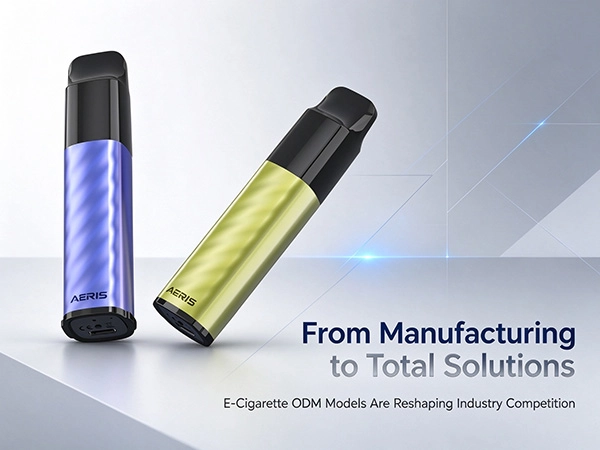
When an ODM only manufactures products, brands can switch suppliers easily based on price. When an ODM owns the core technology platform, manages regulatory filings, and maintains the product’s software, switching costs become enormous. Brands and ODMs enter into multi-year development partnerships, co-creating product roadmaps and sharing market intelligence. This deep integration locks in customer loyalty and creates predictable, recurring revenue streams for solution providers, rather than the volatile order-by-order business of traditional manufacturing.
Value Moves Upstream From Assembly to Intellectual Property
The most profitable part of the value chain is no longer the assembly line. It is the technology platforms, compliance expertise, and design capabilities that enable brands to differentiate. Top ODMs are capturing more of the total product value by monetizing their R&D output, not just their production capacity. This is reflected in rising average ODM unit prices, which increased 3.1% year-over-year in 2025 despite general manufacturing cost pressures, driven by higher adoption of value-added technology modules.
Export Competitiveness Redefines Itself
For Chinese ODMs serving global markets, the competitive playing field is also changing. With export tax adjustments and increasing geopolitical considerations, pure cost advantage is eroding. Solution-oriented ODMs are competing instead on time-to-market, regulatory speed, and technological performance—factors that matter far more to established brands in regulated markets. This has allowed leading Chinese ODMs to retain their dominant global position even as basic assembly capacity begins to diversify geographically.
What This Means for Global Vape Brands
For international brands, distributors, and retailers sourcing e-cigarette products, the rise of the solution ODM model changes how they should evaluate manufacturing partners.
Brands targeting regulated markets such as the U.S., EU, and UK should prioritize ODMs with end-to-end compliance capabilities and a track record of successful submissions in their target regions. The cost savings of choosing a cheaper, less experienced manufacturer will quickly be erased by compliance delays, reformulation costs, or market access failures.
Brands seeking differentiation should look for ODMs with proprietary technology platforms and modular design systems, rather than purely custom builds. Platform-based development delivers better performance consistency, faster iteration, and stronger intellectual property protection compared to one-off custom designs.
For emerging brands and private labels, turnkey ODM solutions dramatically lower the barrier to entry. Instead of investing in R&D labs, regulatory teams, and production facilities, brands can focus resources on marketing, channel development, and customer experience while relying on their ODM partner for the entire product backbone.
Looking Ahead: The Next Phase of ODM Evolution
The e-cigarette ODM industry’s transformation is far from complete. Looking forward, three trends will further deepen the shift toward solution delivery. First, sustainability will become a core solution component as markets implement waste taxes and eco-design requirements, with ODMs offering biodegradable materials and circular product frameworks. Second, smart and health-focused vaping technologies will increase the importance of software and data capabilities within ODM service packages. Third, regionalized production and multi-site supply chains will add logistics and market proximity as key dimensions of solution value.
The era of competing on manufacturing cost alone is over. In today’s global e-cigarette industry, the most successful ODMs do not just make products—they deliver complete market solutions. For brands, choosing the right ODM partner is no longer a procurement decision; it is a strategic choice that defines product performance, speed to market, regulatory risk, and ultimately, competitive survival. As the industry continues to mature, the divide between solution providers and basic manufacturers will only widen, reshaping the competitive landscape for years to come.