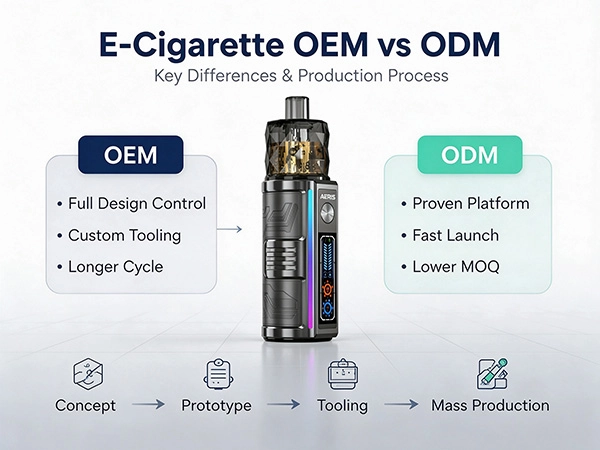
The global electronic cigarette market continues to expand with diversified product demands, making ODM (Original Design Manufacturing) the preferred cooperation model for most international brands. Unlike simple OEM processing, e-cigarette ODM integrates end-to-end technical capabilities from industrial design, structural engineering, atomization research to production verification. The technical level of the ODM partner directly determines the product experience, production yield and market compliance. This article systematically explains the core technical modules of e-cigarette ODM development and the key risks that need to be avoided in the early stage of tooling, to provide reference for brand owners and cross-border importers in product development and supplier selection.
1. Structural Design: The Core Framework of Product Experience and Reliability
Structural design is the primary link in e-cigarette ODM development, which directly affects ergonomic feel, sealing performance, assembly efficiency and service life. A mature structural design scheme needs to balance user experience, production feasibility and cost control at the same time.
1.1 Ergonomic Outer Structure Design
The outer structure design starts from user usage scenarios. For disposable e-cigarettes and pod systems, the grip diameter, mouthpiece radian and overall weight are the core indicators. The mouthpiece area usually adopts a flat oval design that fits the lip shape, and the edge is polished with a large rounded corner to avoid scratching the oral cavity. For closed pod products, the insertion force of the pod needs to be controlled within a reasonable range: too loose will cause poor contact and air leakage, while too tight will bring difficulty in replacement. In addition, the center of gravity design of the whole machine should be biased toward the bottom to avoid the easy toppling of vertical placement products.
1.2 Internal Layout and Airflow System Design
Reasonable internal layout is the premise of ensuring stable product function. The main components include battery cell, atomization chamber, control motherboard, sensor and airflow channel. In the design, the heat source of the atomization chamber should be kept away from the battery and the motherboard to avoid performance degradation of electronic components caused by long-term high temperature. The airflow system directly determines the suction resistance and atomization effect. The air inlet aperture, air guide path and air outlet size form a complete pneumatic loop. The air inlet design usually adopts a single-hole or multi-hole scheme at the bottom, and the suction resistance is adjusted by controlling the total area of the air inlet. For products with adjustable airflow, the structural designer needs to reserve a rotating or sliding adjustment structure on the side, and ensure the sealing of each gear position.
1.3 Leak-proof and Sealing Structure
E-liquid leakage is one of the most common after-sales problems of e-cigarette products, and it is also a key test of ODM structural capability. The sealing design mainly covers three positions: the connection between the atomization core and the oil storage bin, the air inlet and outlet channels, and the assembly gap of the shell. Food-grade silicone sealing rings are the most commonly used scheme, and the design needs to consider the compression ratio of the silicone. Too large compression will lead to assembly difficulty and silicone deformation, while too small will cause sealing failure. For oil storage components, many ODM solutions adopt a double-layer sealing structure, and add oil-absorbing cotton at the bottom of the atomization chamber to absorb a small amount of condensed liquid, so as to avoid oil spit and leakage during use. In addition, the structural design should also consider the pressure balance inside the oil bin, and set up a pressure relief micro-hole to prevent oil leakage caused by thermal expansion and pressure rise in high-temperature environments.
1.4 Material Selection for Safety and Durability
Material selection must comply with food contact safety regulations in target markets, such as FDA in the United States and EU food grade standards. The shell materials are usually PC, ABS, PCTG and aluminum alloy. PCTG material has excellent transparency and drop resistance, and is widely used in pod oil bins. The mouthpiece part prefers PCTG or stainless steel material to avoid peculiar smell. The internal sealing silicone must be made of food-grade platinum-cured silicone, which can withstand high temperature and is not easy to react with e-liquid components. For the electrode part, gold-plated or nickel-plated brass is usually used to ensure conductivity and oxidation resistance.
2. Atomization Solutions: Core Technology Determining Flavor and Experience
Atomization technology is the core competitiveness of e-cigarette ODM, which directly determines the flavor reduction degree, smoke volume and throat hit of products. At present, the mainstream atomization schemes in the industry can be divided into three categories, and ODM manufacturers will match different schemes according to product positioning and e-liquid characteristics.
2.1 Mainstream Atomization Core Technologies
The cotton coil scheme is the earliest mature technology. It uses organic cotton as the oil guide material and wraps the heating wire inside. Its advantage is that it has good flavor reduction ability for complex e-liquid, and the production cost is low. However, the consistency of manual winding is poor, and it is prone to dry burn if the oil guide speed is not well controlled. The ceramic core scheme uses porous ceramic as the oil guide matrix, and the heating wire is sintered inside the ceramic. It has the advantages of uniform heating, high atomization fineness and not easy to paste core. It is widely used in medium and high-end pod products. However, ceramic cores have higher requirements for e-liquid viscosity, and improper matching will lead to poor oil guide and weak flavor. The mesh coil scheme adopts a sheet-shaped metal mesh as the heating element, with larger heating area and faster heating speed. It can bring larger smoke volume and rich flavor at the same time, and has become the mainstream scheme of disposable e-cigarettes. In ODM development, it is necessary to select the atomization core scheme according to the product's target crowd, e-liquid formula and cost budget, and carry out targeted debugging.
2.2 Optimization of Atomization Efficiency and Flavor Reproduction
High-quality atomization effect cannot be achieved only by the atomization core itself, but also needs the cooperation of power output, airflow speed and oil guide speed. ODM technical teams usually adjust the power curve of the chip to match the resistance value of the atomization core, so as to ensure that the heating rate is within the optimal atomization temperature range of e-liquid. The airflow velocity will affect the mixing degree of smoke and air. Reasonable airflow design can bring fuller smoke and avoid the problem of hot smoke. In addition, the oil guide speed of the atomization core must match the atomization speed. Too fast oil guide will cause insufficient atomization and oil spit, while too slow will lead to dry burn and burnt taste. In the development stage, a large number of flavor tests and durability tests are required to continuously optimize the matching parameters.
2.3 Temperature Control and Dry Burn Prevention Technology
Dry burn not only affects the taste, but also shortens the service life of the product and even brings safety risks. The mainstream ODM scheme realizes dry burn prevention through chip control and structural optimization. On the electronic control side, the chip monitors the resistance change of the heating wire in real time. When the temperature exceeds the threshold, it will automatically reduce the power or stop heating. On the structural side, the oil storage design ensures that the atomization core is always immersed below the liquid level before the e-liquid is exhausted, and the oil guide hole is set at a reasonable height to avoid the core being exposed to the air in advance. For products with long-term use requirements, some ODM solutions also add e-liquid reminder function, which reminds users to replace or add liquid through indicator lights or vibration when the liquid level is low.
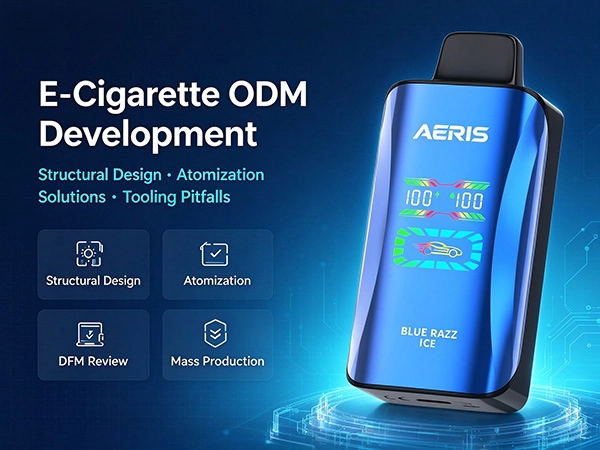
3. Critical Pitfalls to Avoid in E-Cigarette ODM Development and Tooling
Many brands focus only on appearance design and cost quotation in the early stage of ODM cooperation, ignoring technical verification before mold opening, which leads to repeated mold modification, delayed mass production or even product scrapping. The following are the most common technical pitfalls in e-cigarette ODM development.
3.1 Insufficient DFM Review Before Mold Opening
DFM (Design for Manufacturing) review is the most critical link before mold opening. Many brands directly open molds after confirming the appearance design, without evaluating whether the structure is suitable for mass production. For example, too thin wall thickness will lead to difficult injection molding and high defective rate; unreasonable buckle design will increase assembly time; the size tolerance of internal components does not match, which will lead to poor consistency of finished products. A professional ODM manufacturer will carry out comprehensive DFM review on structural drawings, evaluate injection molding process, assembly efficiency, production yield and maintenance cost, and feed back optimization suggestions to the brand side. Skipping this link will often lead to multiple mold repairs after mold trial, which will not only increase the cost but also delay the product launch cycle.
3.2 Lack of Consistency Verification of Atomization Performance
The atomization effect of a single prototype cannot represent the level of mass production. Many products have good taste in the sample stage, but after mass production, there are large individual differences, which leads to a surge in after-sales complaints. This is mainly because the ODM side has not established a complete consistency verification system. In the pilot production stage, it is necessary to randomly select products from different batches of atomization cores and different assembly lines for comprehensive testing, including resistance value deviation, smoke volume consistency, flavor stability and leakage rate under high and low temperature environments. Only when the consistency index meets the standard can formal mass production be carried out. In addition, the reliability test of the whole machine, such as drop test, high and low temperature storage test and cycle suction test, is also an essential verification link.
3.3 Ignoring Regulatory Compliance Requirements in Target Markets
E-cigarette products are subject to strict regulatory requirements in various countries, and compliance design must be considered at the beginning of ODM development, rather than remedying after the design is completed. For example, the EU TPD stipulates the maximum oil storage capacity, nicotine content and warning label size of products; the US FDA has detailed requirements for product ingredients, production environment and submission materials; some regional markets also require child lock function and battery safety certification. If the structural design does not reserve the position of warning label, or the oil bin capacity exceeds the regulatory limit, the product cannot be legally sold in the target market. A reliable ODM partner will be familiar with the regulations of major markets around the world and give compliance suggestions in the design stage to avoid the risk of product detention or recall.
3.4 Supply Chain and Mass Production Ramp-up Risks
The smooth progress of ODM development depends on the stability of the upstream supply chain. Some ODM manufacturers adopt customized special components in design, but the supply of these components is single-source, which is prone to shortage or price fluctuation in the mass production stage. In addition, if the design is too dependent on manual assembly, it will be difficult to increase the production capacity rapidly, and the product quality will be uneven. Therefore, in the development stage, it is necessary to confirm the supply channels of core components such as batteries, atomization cores and chips with ODM suppliers, and try to choose general-purpose and multi-source supply components. At the same time, the structural design should give priority to automatic assembly schemes to reduce manual intervention and ensure the stability of mass production capacity and quality.
Conclusion
E-cigarette ODM development is a systematic project integrating multi-disciplinary technologies. Structural design determines the basic reliability and experience of products, atomization scheme is the core of product competitiveness, and scientific avoidance of development pitfalls is the key to ensure smooth product launch and cost control. For brand owners and importers, choosing an E-cigarette ODM manufacturer with complete technical research and development capabilities, complete testing system and rich compliance experience can not only ensure product quality, but also greatly shorten the development cycle and reduce market risks. In the increasingly competitive global e-cigarette market, technology-driven product iteration will always be the core driving force for brand growth.